

Makhado Colliery ground to a halt on 1 October 2026, five days before the Minister dismissed the appeal against it. It must not restart. We call on the Industrial Development Corporation* to ensure that not one rand more of public money is poured into the pit at Makhado; not one more hectare of the Vhembe stripped for a mine that has never paid its own way and now cannot pay its debts. Twice this company has gambled a living landscape on a failed venture, and twice the regulators have held its coat. The Vhembe will no longer be sacrificed to a foreign coal company whose own books say it can’t pay for what it has broken.
The Critical Biodiversity Area in Vhembe on which the suspended Makhado Colliery now stands, source: Living Limpopo, May 2026
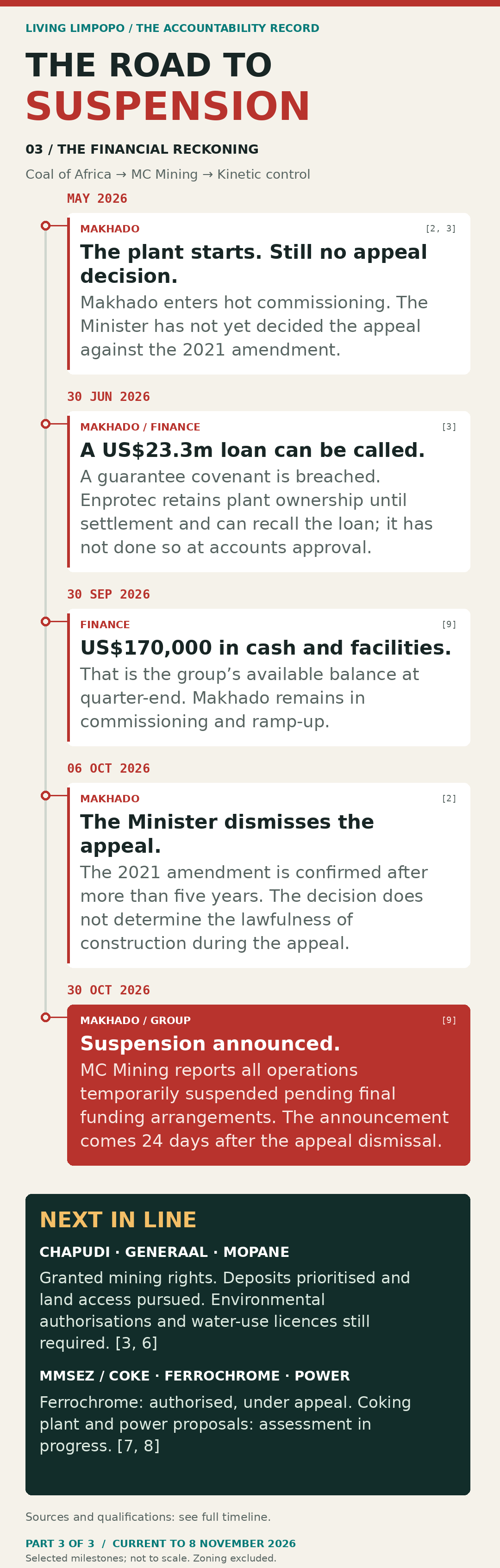
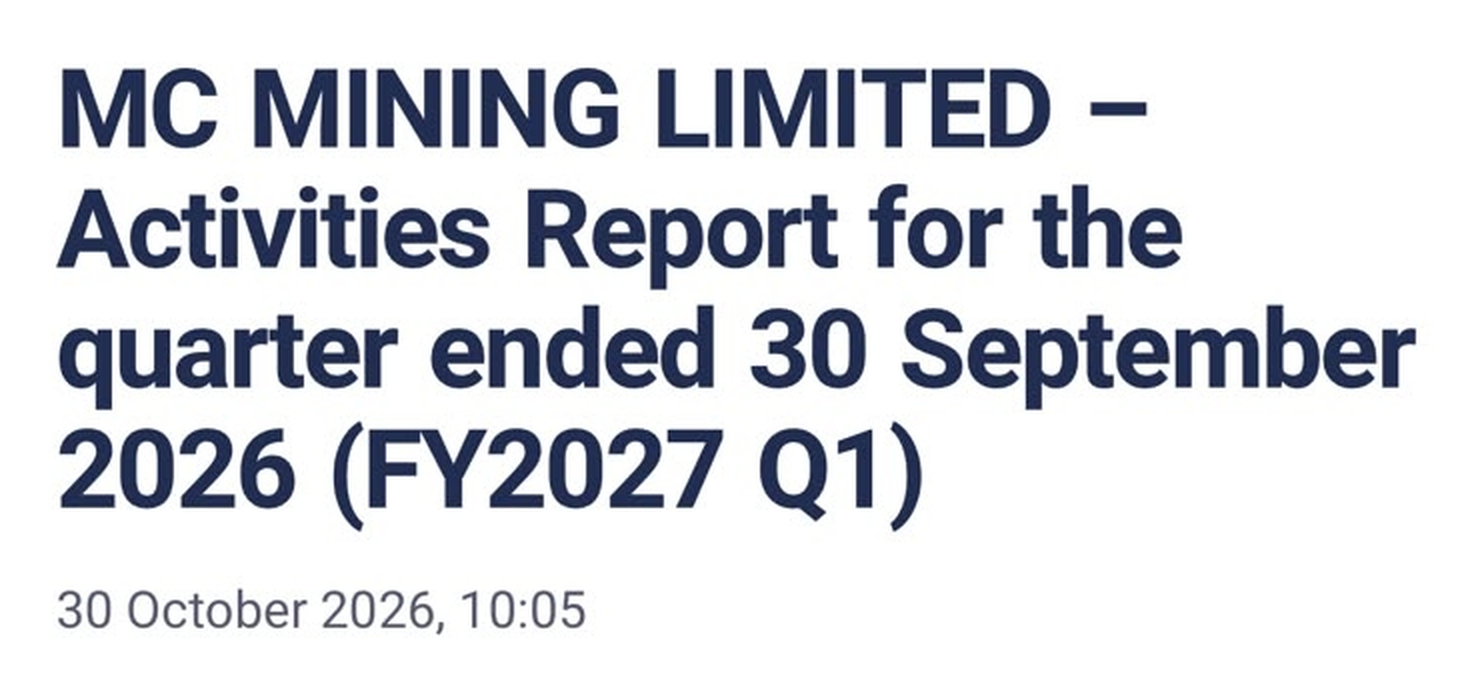
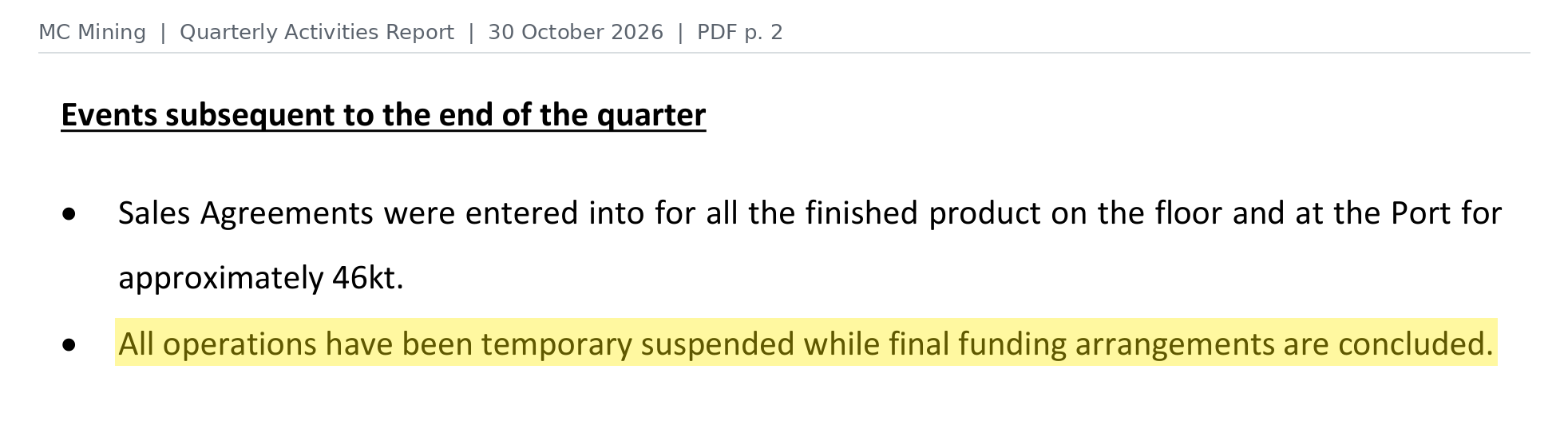
On 30 October 2026, MC Mining announced on the Johannesburg and Australian stock exchanges that "all operations have been temporarily suspended while final funding arrangements are concluded." On 9 November it admitted that the mine had in fact stopped on 1 October, that the Board has now formally suspended mining and production, and that there is no committed funding to restart.
Look at what that sentence leaves behind. Open coal pits stand where baobabs stood for a thousand years. Critical Biodiversity Areas, mapped and designated by the State itself, have been stripped bare, on land the State holds in trust for the Mphephu Traditional Council. None of it can be undone.
Living Limpopo and a coalition running from the Mudimeli Village fence line to organised agriculture, from indigenous custodians to the conservation sector, have fought this mine at every step of the way. We said it would fail. We said it would leave the land broken and the bill unpaid. Since construction began in November 2024, we have demanded, in writing, in Parliament and before the prosecuting authority, that the law be enforced against a mining company building a coal mine in open defiance of every statutory guardrail on the books: an authorisation under appeal, a licence for the water still promised to agriculture, a rehabilitation guarantee a fraction of the real liability. Not one regulator acted.
Sixty-four months to decide whether a mine could be built, while it was built
Makhado's environmental authorisation dates from 2013 and would have expired in July 2021. In March 2021, MC Mining admitted that it had failed to commence, told the Department it was "unlikely" to do so by the time the authorisation lapsed, and asked for three more years. The Department gave it something it had not asked for, and the regulations do not provide: it deleted the deadline altogether, so an authorisation about to expire never would. On 30 June 2021, communities and stakeholders appealed. Under section 43(7) of the National Environmental Management Act, an appeal suspends authorisation. The mine was built anyway: Construction began in November 2024, commissioning began in May 2026.
On 6 October 2026, the Minister of Forestry, Fisheries and the Environment, David Maynier, dismissed the appeal. It had taken four ministers and 64 months - against the regulations' 50 days - to decide whether a mine could be built, while it was built. The decision finds, on no evidence, that the mine had "commenced" before July 2021, a finding contradicted by the company's own application and its subsequent public disclosures. It does not deal with whether it was lawful to have built the mine before he had decided the appeal. The company and the authorities have insisted that only the amendment was suspended, not the underlying authorisation, yet the amendment restored an authorisation that had otherwise lapsed. Suspend that amendment, and there is no authorisation left to build under. The contradiction is plain to see. The Minister is silent on the question. Read our full report on the appeal decision.
We now know the mine had already stopped five days before he signed. He sanctioned a mine that was no longer running, and the company waited 29 days to tell the market.
A hole in the ground, and nothing in the bank
Read the company's own numbers. At 30 September it had US$170,000 in available cash and facilities. During the quarter it borrowed another US$10.2 million from its Chinese controlling shareholder, Kinetic Development Group, and spent it. Customer receipts: nil. It delivered 4,846 tonnes of coal to Matola. The next day, it stopped.
The audited accounts are worse: a US$17.8 million loss. Current liabilities of US$54.4 million against current assets of US$4.6 million. An eighth consecutive going-concern warning from its auditors. A CIPC investigation into reckless trading has been open since August 2025. Accumulated losses of US$997 million on US$1.16 billion raised from shareholders: eighty-six cents in every dollar, gone.
The plant is not theirs, and the loan is in default
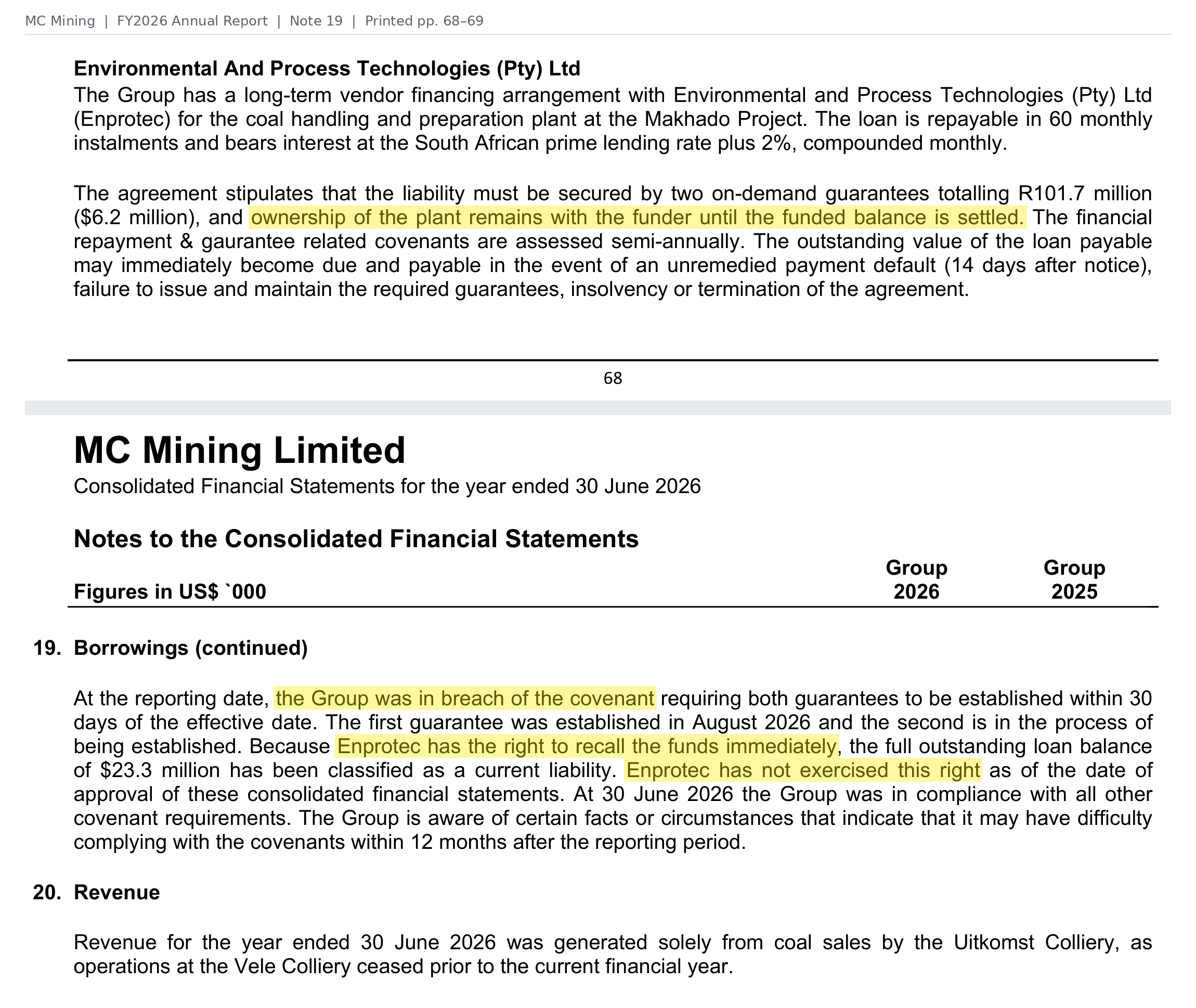
Buried in note 19 of the Annual Financial Statements released on 30 September: the coal washing plant does not belong to MC Mining. It belongs to the contractor that built it, Enprotec, under a US$23.3 million vendor-finance deal, "until the funded balance is settled". In the company's words:
"The Group was in breach of the covenant … Enprotec has the right to recall the funds immediately … The Group is aware of certain facts or circumstances that indicate that it may have difficulty complying with the covenants within 12 months."
In plain language: a loan default, disclosed by the company itself, on the one asset that produces saleable coal from rock. Somebody else owns it.
So, the "Makhado asset" is a pit, a stockpile, a borrowed plant and a company that cannot pay its bills. It says it stopped for “funding”. Its own books say the cash ran out before the mine had even started paying for itself. Now it concedes the plant and the mine plan need rework, and that the US$8 million its parent advanced on 9 November only pays for the shutdown, severance packages and a “business plan review”, not a restart. Its own announcement calls this a “care and maintenance period”. We are entitled to ask whether this mine ever had a business, or was always a stock-exchange story dressed up as a colliery.
What we hear in the district is talk among contractors' crews, not verified fact: that MC Mining owes its contractors and its diesel supplier millions more, and that creditors are weighing an application to wind the company up. We cannot confirm it, but the accounts point the same way: trade payables up 56 per cent in a year, and a going-concern forecast resting on "continued support from critical suppliers and creditors".
We have seen this movie. It was called “Vele”.
In 2010, the same company, then Coal of Africa, began building Vele Colliery, seven kilometres from the Mapungubwe National Park and UNESCO World Heritage Site, without environmental authorisation. At that time the State moved swiftly. The Green Scorpions served a compliance notice within days, construction was stopped, and a criminal docket was opened. Two UNESCO missions were dispatched to South Africa and found open-cast mining would irreversibly damage the landscape. The company paid a R9.25 million fine and bought a retrospective authorisation, conditional on a R55 million "biodiversity offset" to SANParks – cash for coal beside a World Heritage Site. In 2014, the State gazetted a prohibition on new mining across an enlarged Mapungubwe buffer zone. All of it inadequate, but more than Makhado has ever drawn in accountability. Vele produced its first coal in December 2011, was mothballed in August 2013, and has operaed for a total of 27 months in 15 years.
Now Makhado: the same contravention, the same Act, the same Department, now under GNU oversight. Construction commenced without valid environmental authorisation. A 20,432-signature petition, an open letter to the Minister and the National Director of Public Prosecutions, a parliamentary request for a cessation notice: no compliance notice, no directive, no charge. The mining inspectorate visited this very quarter and, the company boasts, gave "positive feedback". Then the mine stopped, and five days later the appeal was dismissed.
Same company. Same calculation: ask forgiveness, not permission; a fine is cheap, and delivers a permit - a mine already built is a mine nobody will unbuild. Vele proved it. Makhado banked on it.
The Save Mapungubwe Coalition fought Vele with courage, determination and the best evidence in the country, and was right about everything: the water, the coal, the heritage, the jobs. It did not lose the argument. It was systematically undermined. The Minister lifted the suspension of the mine's water licence without hearing the Coalition's appeal; a retrospective authorisation turned a crime into a fine; an offset deal was signed over its head; the only seat left was on a monitoring committee for a mine that then died anyway. Nobody in government has answered for the wreckage left in its wake.
This time, we intend to finish the job.
Nothing gained. Irreversible loss.
The 1,106 permanent jobs used to buy consent for the Makhado project have shrunk to 650 on paper; 58 in law. When the Competition Commission approved MC Mining’s takeover by Kinetic in March 2025, the only enforceable employment condition it imposed was the creation of 58 permanent jobs at Makhado within a year. Fifty-eight jobs, for a mine sold to the public on more than a thousand. The annual report discloses no permanent operating workforce at all. Seven months after the takeover closed, the company has invited employees to apply for voluntary severance and will not rule out compulsory retrenchments.
The 355,845 cubic metres of water a year that was promised to host communities at Mudimeli and nearby villages under the terms of Makhado’s water use license has never been delivered. Not one provision of the underlying 2012 “New Water” agreement - under which irrigation entitlements were to be transferred to the mine- has ever been discharged, yet the mine holds a licence for that same water in a catchment the Department itself records as already in deficit. Arsenic in boreholes on the neighbouring conservation area rose from 2.83 to 426 micrograms per litre, 42 times the drinking-water limit, and was reported to the Department in August 2025, which inspected, took no samples, cleared the mine on the mining company's own report, and has never published the audit the Minister promised Parliament for January 2026.
The bill is coming. It is addressed to you, taxpayer.
The rehabilitation guarantee held against Makhado is R77.4 million. In October 2025, Minister Gwede Mantashe told Parliament in response to questions that it was "deemed sufficient". The company's own accounts have since lifted its rehabilitation provision tenfold, to US$21.2 million, around R350 to R380 million. Independent valuer, SRK, puts the whole-of-life closure cost at roughly R747 million; no complete closure estimate has ever been prepared. Section 46 of the Mineral and Petroleum Resources Development Act says what happens when a mining company ceases to exist and its guarantee falls short: the work is paid for "from money appropriated by Parliament".
A company with US$170,000 in the bank, a borrowed plant and a disclosed default will not restore a Critical Biodiversity Area in a catchment already in deficit. If it goes under, you will pay. The land will not be restored; it will be nursed as a perpetual invalid, at public expense, by your grandchildren.
Why this is bigger than one mine.
Kinetic Development Group, through its subsidiary, MC Mining, holds mining rights over roughly 100,000 hectares of the Greater Soutpansberg Coalfield at Chapudi, Mopane, and Generaal – all within the UNESCO Vhembe Biosphere Reserve, almost all within the Limpopo Conservation Plan’s Critical Biodiversity Areas. Kinetic Development Group is also the anchor investor in the Musina-Makhado Special Economic Zone, with a 1-million-tonne-per-annum ferrochrome smelter authorised in May 2026 (now under appeal by Living Limpopo and others) and applications in progress for a 3-million-tonne-per-annum coking plant and power station. A Chinese coal mining company that could not keep its one mine running for two months is the same company entrusted by our government with an entire coalfield and a heavy industrial mega-project. What could go wrong?
This must stop. Now.
Makhado must not restart on borrowed money, and not one more hectare of the Vhembe, not one baobab, not one drop of the Nzhelele, the Sand or the Limpopo River may be surrendered to the next doomed coal venture. We have watched this before: a company that mines capital rather than coal, and a government that signs whatever is put in front of it and calls the wreckage development. The greed was always theirs. The recklessness was always the State's. The land has paid for both. It will not pay again.
* The IDC is not a bystander here. It is a creditor owed public money and, through the shares it was handed as a "sweetener" on that loan, a part-owner of the company that holds the Makhado mining right. Every deferral it has granted since 2017 has kept this venture alive; every rand it is still owed converts into a bigger public stake in the wreck. South Africans own a piece of this pit. The IDC must now use that position: refuse to fund or consent to any restart on borrowed money, refuse to convert its debt into more equity in a failed mine, and demand an independent closure assessment and full financial provision before a single tonne is moved. It told Parliament it expected full recovery. It should tell the public how.
We demand answers
Living Limpopo is putting the questions this collapse raises, in writing and in public, to the Minister of Forestry, Fisheries and the Environment, David Maynier; the Minister of Water and Sanitation, Pemmy Majodina; the Minister of Mineral and Petroleum Resources, Gwede Mantashe, and his inspectorate; the Companies and Intellectual Property Commission; the Competition Commission; and the Industrial Development Corporation. We will also ask who, among the directors who built this mine while the appeal was pending, is to be held to account for it. Section 34 of the National Environmental Management Act makes directors personally liable for environmental offences committed by their company; a resignation letter does not discharge that liability. Read the questions here: We will publish every reply, and every silence.
Join Living Limpopo. Add your voice to a campaign defending water, livelihoods and a different future for this landscape. Join us, volunteer your time or skills, or simply share this article with someone who should read it.
Please consider a donation. Even the smallest contribution to our war chest helps enormously. You would not believe how far we stretch each rand: to investigate, challenge, document and keep these questions in front of decision-makers. Donate with PayFast or PayPal.
Living Limpopo is a member-based public advocacy organisation working for biodiversity-led development and accountability in the Vhembe District. Sources: MC Mining FY2026 Annual Report (30 September 2026); MC Mining Quarterly Activities Report to 30 September 2026 (30 October 2026); MC Mining SENS announcement, KDG Bridge Loan, Makhado Operations and Director Resignation (9 November 2026); Competition Commission conditions, Government Gazette 52348, Notice 3074 (20 March 2025); Living Limpopo, MC Mining Company Profile and Risk Assessment (October 2026); parliamentary replies cited therein.