

CRITICAL UPDATE: Rights of Nature Denied
The world condemns South Africa. The neo-colonial industrial advance accelerates.
In March 2026, two things happened almost at once. The International Rights of Nature Tribunal, sitting in Belém, Brazil, issued its judgment on the Musina-Makhado Special Economic Zone case and declared the MMSEZ a sacrifice zone. In the same month, the South African government gazetted the draft Musina-Makhado Regional Spatial Development Framework: a sweeping land management and development plan for the MMSEZ region, to guide mining expansion, industrialisation, and urbanisation across a 3-million-hectare area.
That coincidence matters. While the world was condemning South Africa for ecocide, the state was moving ahead with a planning instrument designed to lock in a coal mining and coal-fuelled industrial trajectory across the Vhembe landscape.
This is not a story about a coal mine, or a smelter, or a power plant. It is the story of a vast, transboundary, foreign-controlled, coal-mining-industrial corridor, being driven through China’s SEZ model with accelerating momentum, despite mounting legal, economic, ecological and human rights violations.
The chronology tells the story
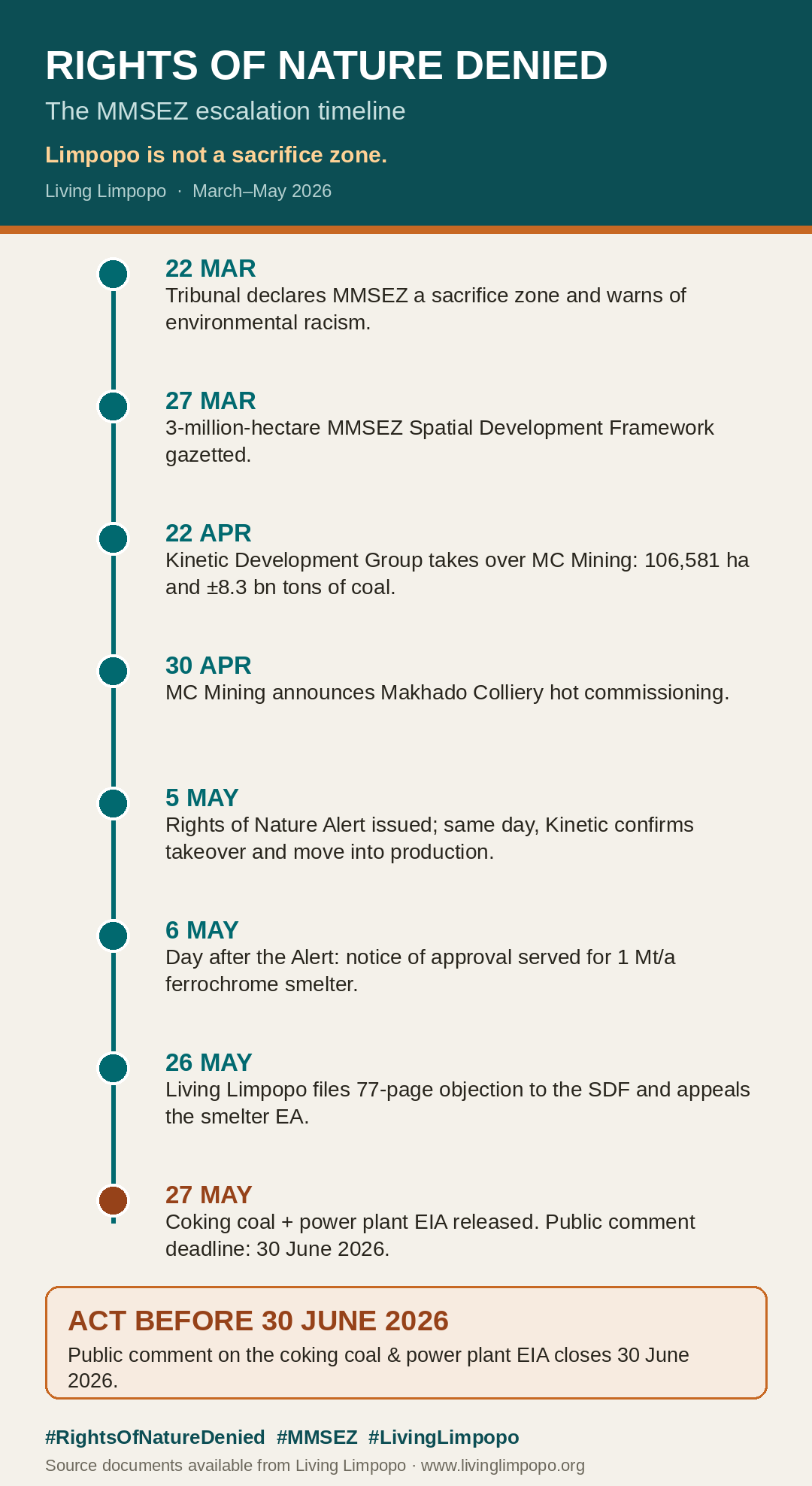
On 22 March 2026, the Tribunal found that the MMSEZ violates the rights of nature and communities, and warned that it reflects environmental racism and systemic governance failure in South Africa.
Then, less than a week later, on 27 March 2026, the draft MMSEZ Regional Spatial Development Framework was gazetted for public comment, mapping out a 3-million-hectare land grab for coal mining, heavy industry, and the publicly subsidised power, water and transport infrastructure to support them.
Then came the consolidation of foreign corporate control over Limpopo’s future, bound to coal and dirty industry. On 22 April 2026, Hong Kong-listed Kinetic Development Group completed its takeover of MC Mining, acquiring a controlling 51% stake for almost US$100 million. The significance of that transaction can hardly be overstated: through MC Mining, Kinetic now holds strip-mining rights over 106,581 hectares across the Greater Soutpansberg Coalfield, covering nine licensed open-pit coal projects and roughly 8.3 billion tons of coal resources. A single foreign corporation now controls the coal supply base that underpins the MMSEZ, while also standing as the SEZ’s anchor investor.
Eight days later, on 30 April 2026, MC Mining announced hot commissioning of the Makhado Colliery despite critical legal and water failures.

Image Copyright: Scott Ramsay
On 5 May 2026, the Rights of Nature Tribunal issued a fresh Alert on the MMSEZ, warning that the window to prevent irreversible harm was rapidly closing.
The next day, 6 May 2026, the conflicted Limpopo provincial government department responsible for the MMSEZ, LEDET, gave notice that it had granted Environmental Authorisation to Kinetic for a 1-million-ton-per-annum ferrochrome smelter in the MMSEZ, despite objections by Livining Limpopo and other interested and affected parties to catastrophic defects in the EIA process. The message is unmistakable: international condemnation would not slow the fossil fuel-driven industrial advance in Limpopo.
What followed in late May only deepened that pattern of reckless defiance. On 26 May 2026, Living Limpopo lodged a 77-page objection to the draft MMSEZ Regional Spatial Development Framework and, on the same day, filed its appeal against the ferrochrome smelter approval. Almost immediately, on 27 May, the EIA for Kinetic’s 3 million-ton-per-annum coking plant and power plant was released, with a narrow window for public comment.
What this reveals
Taken together, these are not disconnected administrative events. They form a coordinated, connected cascade: planning, foreign corporate control of resources, mining, industry, power generation, water resource development and land use restructuring, all moving in tandem.
The core failure here is cumulative:
The MMSEZ was set in motion without a proper cumulative environmental assessment, and nine separate mining licences were issued to the same mining company for what amounts to a near-contiguous 100,000-hectare coal mine. Now, across the Limpopo River in Zimbabwe, the Chinese-backed Palm River Energy Metallurgical Special Economic Zone is taking shape too, pointing to a cross-border coal-and-metallurgical corridor linked to Chinese industrial strategy and the Belt and Road Initiative. This is the wider reality that narrow, project-by-project EIAs systematically obscure.
The scale of what is being advanced is staggering:
The broader MMSEZ-coalfield complex encompasses a 100,000-hectare open-pit coal mine across the Greater Soutpansberg Coalfield, an 8,000-hectare heavy industrial zone creating 16 million tons per annum ferroalloy and steel over-capacity, 3,500 MW of power generation, a mega-dam on the Limpopo River and a regional land use and spatial development framework spanning some 3 million hectares. This is not incremental development of organic industries. It is an attempt to reorder an entire landscape around coal extraction and coal-based heavy industry.
The promised benefits are paltry:
The ferrochrome smelter is projected to create only 235 operational jobs, with 40% of senior roles reserved for Chinese staff. The takeover conditions imposed by DTIC Competition Tribunal on the merged Kinetic Resources/MC Mining entity require the creation of only 58 permanent jobs at Makhado Colliery. Set against a mega-project of this magnitude, the scale of the resources and land rights being transferred, and the fiscal, environmental, social and economic costs being imposed - including the job losses that will be sustained in agriculture, tourism and the cannibalised domestic steel industry - those numbers expose the hollowness of the jobs narrative that has long been used to justify sacrifice-zone development.
Pollution dumping dressed up as “development”
Makhado Colliery site, aerial footage captured by Nick Chevallier, April 2026
Most chillingly, the smelter project’s economic rationale explicitly presents the transfer of surplus energy-intensive industry and industrial pollution from China to South Africa as a benefit. Yet even as it justifies this pollution dumping, the EIA grossly understates the human health impacts of industrial pollution, by modelling emissions at only one-eighth of permitted capacity, while projecting economic benefits at full scale, and by ignoring the risk that hexavalent chromium — a potent carcinogen — could contaminate the sole-source aquifer on which surrounding communities depend.
Nor are these harms hypothetical.
They are already unfolding on the ground: alongside the destruction of a swathe of Critical Biodiversity Areas, evidence of arsenic contamination has already been detected in the core of the 3,600-square-kilometre groundwater impact zone around Makhado Colliery.
The JET hypocrisy
The MMSEZ will consume 23 million tons of coal annually for the next 30 years, pumping a gigaton of carbon into the earth’s atmosphere – 33 million tons annually, 17% of South Africa’s carbon budget by 2035 under NDC3.0.
The moral core of this story is that South Africa is accepting billions in Just Energy Transition finance with one hand, while using the other to open a new coal resource in Limpopo in a foreign-controlled industrial corridor and dumping the burden of pollution onto frontline communities.
This is why the Tribunal’s language matters. A sacrifice zone is not a metaphor. It is a place where nature, the law, health and communities are treated as expendable in service of concentrated economic power.
Law and rights trampled
The MMSEZ was unlawfully declared by the Minister of Trade and Industry without an EIA. On that unconstitutional foundation, the Minister of Land Reform has now pushed forward a 3-million-hectare MMSEZ Regional Spatial Development Framework — still without any proper cumulative impact assessment, socio-economic cost-benefit analysis, consideration of alternatives, or meaningful public participation. Meanwhile, a deeply conflicted provincial department has been left to authorise the very project it promotes, and Makhado Colliery is moving into production while its appeal remains pending before the Minister of Environment, its water plan has collapsed, and the Minister of Water responds with little more than empty promises as the threat to the Nzhelele river system intensifies. This is not sustainable development. It is a full-scale assault on environmental law, constitutional rights, and Limpopo’s future.
This is not a Just Transition. It is an unjust betrayal.
This is not development. It is environmental racism.
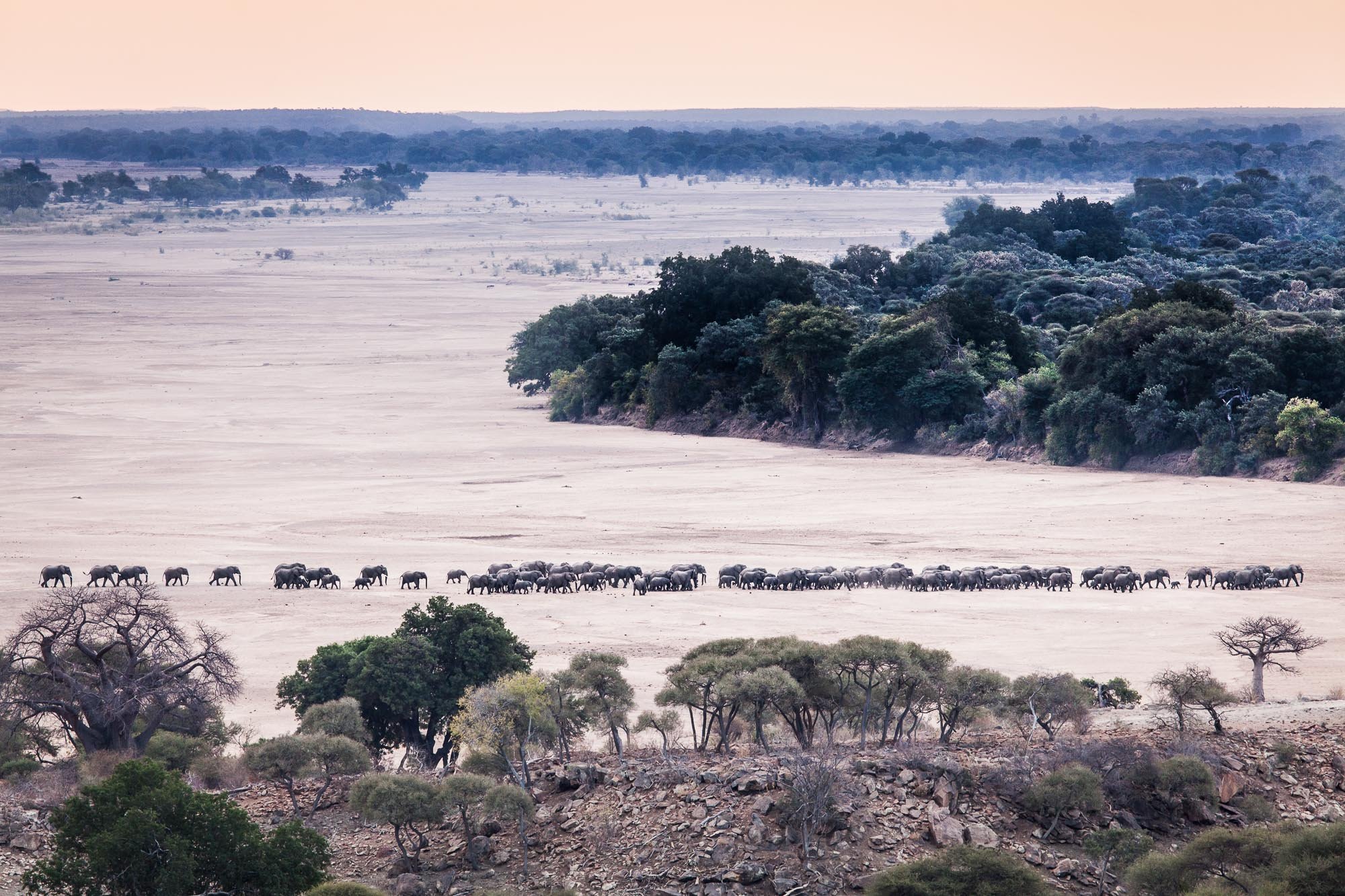
Image donated by Scott Ramsay
DEADLINE FOR COMMENT AND OBJECTION:
On 27 May 2026, the draft Environmental Impact Assessment (EIA) Report for Kinetic’s coking coal plant and power plant was released for public comment. The public has less than two weeks to submit comment — the deadline is 30 June 2026.
Access the EIA Report for the Kinetic MMSEZ Ferrochrome Smelter Project and Coking and Heat Recovery Power Plant Project here:
Living Limpopo will meet the deadline and stand for your rights as we build a stronger legal defence — but we need your support: if you have R1 to give, please give it to our war chest; if you have only your voice, raise it; if you believe in a different future for Limpopo, sign up as a member and be counted among the thousands standing with us.
Donate now with Pay Pal
Donate now with Pay Fast (any currency)
Resources: Rights of Nature Tribunal Judgement and MMSEZ Alert issued 5 May 2026
Rights of Nature Alert: MMSEZ, A Sacrifice Zone Unfolding in South Africa
Living Limpopo Press Statement, 11 May 2026: South Africa Defiant in Face of International Condemnation for MMSEZ “Sacrifice Zone”
Media contact: Leanne McCann | Living Limpopo