

LIVING LIMPOPO AND ALLIES FILE URGENT OBJECTIONS TO CHINA-BACKED MEGA-POLLUTER PROPOSED FOR UNESCO BIOSPHERE RESERVE
PRESS STATEMENT
FOR IMMEDIATE RELEASE — Wednesday, 01 July 2026
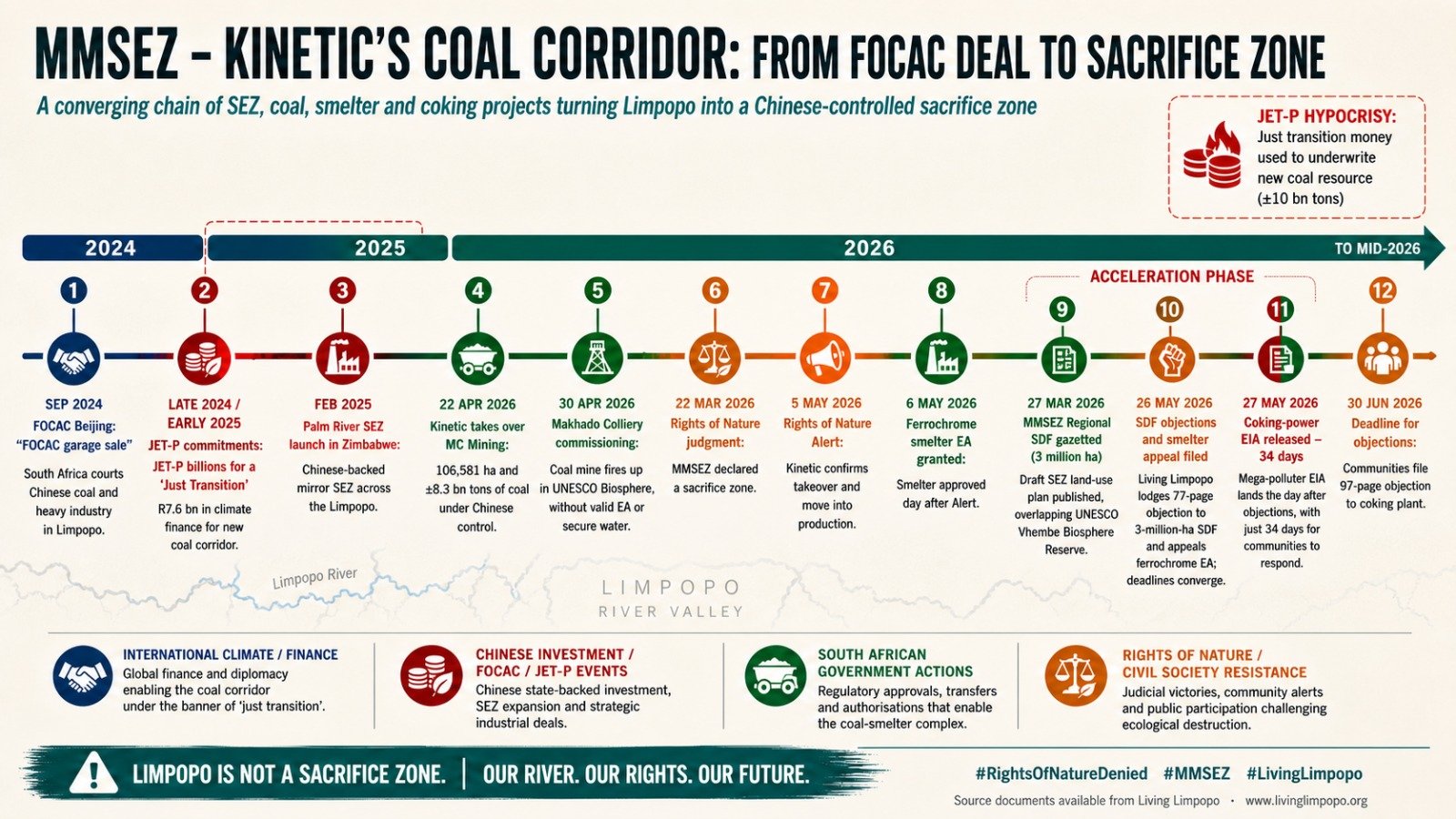
A 3-million-ton-per-year coking and power plant linked to the MMSEZ coal-industrial megaproject in Limpopo's Vhembe Biosphere — while South Africa pockets R7.6 billion in green transition funding
Communities and organisations defending South Africa's Vhembe Biosphere Reserve filed urgent formal objections last night to a proposed Chinese-backed coking plant and 390 MW industrial power station — part of the biggest and one of the most polluting industrial developments ever conceived for southern Africa. The Musina-Makhado Special Economic Zone, into which this plant feeds as a critical link in a coal-to-coke-to-steel chain, would at full build-out obliterate 136,000 hectares of critical biodiversity areas for open-pit coal mining and heavy industry, produce 16 million tons per year of metallurgical output, and pump over one billion tons of CO₂ into the atmosphere over its 30-year lifetime — in a country that has just accepted R7.6 billion in international funding to move away from coal. The 97-page submission, filed minutes before the 30 June 2026 deadline, exposes regulatory deception, falsified emissions data, broken jobs promises, and the systematic exclusion of affected communities.
Filed by Richard Summers Inc. Attorneys on behalf of: Living Limpopo NPC; Earthlife Africa NPO; Vhembe Biosphere Reserve NPC; The Herd Nature Reserve NPC; Elephants Alive NPC; The Lepidopterists' Society of Africa.
THE PROJECT
Kinetic Mining Development South Africa (Pty) Ltd — the South African subsidiary of Hong Kong-listed Kinetic Development Group Ltd — proposes a 3-million-ton-per-year coke plant and 390 MW power station on Farm Boas, 2 km from Mudimeli village, inside the Vhembe Biosphere Reserve. A twin facility is allegedly planned inside the MMSEZ boundary. The site sits adjacent to Kinetic’s Makhado Colliery — under construction while its environmental authorisation remains under appeal and its water supply plan has collapsed — and near Kinetic's ferrochrome smelter in the MMSEZ Energy-Metallurgical Zone, granted a controversial environmental authorisation in April 2026, now under appeal. Together, these three projects form a vertically integrated industrial chain built on a marginal coal resource that will inflict grossly net-negative economic impacts on South Africa.
The EIA runs to 2,080 pages across 20 specialist reports. The public had 34 days to comment.
KEY OBJECTIONS
💀 THE JOBS FRAUD
At the September 2024 public launch, the EAP, Gudani Consulting, promised 3,000 jobs. The EIA now states 874. Gudani's explanation: those 3,000 jobs belonged to a different — allegedly separate — coking plant on the adjacent MMSEZ site. The MMSEZ's planning documents project 7,841 jobs for these two projects combined: 6,161 for the ferrochrome smelter and 1,680 for the coking plant. What has materialised: the ferrochrome smelter was authorised for 235 permanent posts with 40% of managerial positions reserved for Chinese nationals. This coking plant: 874. That is 1,109 jobs against a promise of 7,841 — an 86% reduction. When South Africa's Competition Tribunal approved Kinetic's acquisition of junior mining house MC Mining — and with it, rights to an 8.6-billion-tonne coal resource in the Greater Soutpansberg Coalfield — in March 2025, the best it could extract as a binding public interest commitment was 58 permanent jobs for the entire Makhado Colliery.
The MMSEZ has been sold to the public on a promise of 21,000 jobs. At the same reduction ratio, the real number is closer to 2,500. This is not a planning revision. It is a systematic pattern of inflating benefits to secure consent, then discarding the promises once approvals are in hand.
💧 NO WATER
The plant will consume up to 3.7 million cubic metres of water per year from the Nzhelele River catchment — confirmed by DWS as already over-allocated. The feasibility study for the proposed Musina Dam and Limpopo River inter-basin transfer scheme — the only identified source capable of supplying the MMSEZ's combined water demands — has been suspended, leaving the entire mining-industrial complex without a credible water supply plan. Kinetic's flagship coal mine is about to enter production without a lawful water source after the collapse of its 1.8 million m³/year transfer agreement from the Nzhelele irrigation scheme to the mine. Independent monitoring has found arsenic at 42 times the drinking water standard in community boreholes near the Makhado Colliery. The Minister of Water has confirmed a DWS compliance audit is underway. LEDET has not waited for the outcome. Every additional cubic metre demanded by this plant is a cubic metre that does not exist — and its approval would place the entire Nzhelele River system, every farmer, every village borehole, and every ecosystem dependent on this water under a compounding stress whose consequences for the long-term survival of the catchment are almost impossible to overstate.
🤚 COMMUNITIES SILENCED — AND A GLOBAL VERDICT IGNORED
When the Scoping Report was released in December 2025, and again when the Draft EIA was released in May 2026, 253 registered I&APs received zero notification. The entirety of community notification for Mudimeli village — home to the people closest to this plant — was a single site notice at the Mudimeli Post Office posted for one day: 20 September 2025. The only public meeting held — 27 September 2025 — erupted when communities connected the project to MC Mining's broken promises. Police were called. The meeting was abandoned. No replacement was ever held.
In December 2025, Makoma Lekalakala — Director of Earthlife Africa and 2018 Goldman Environmental Prize laureate — gave expert testimony to the International Rights of Nature Tribunal on the MMSEZ. On 22 March 2026, from Belém, Brazil, the Tribunal delivered its verdict: "the creation of the MMSEZ has constituted a veritable sacrifice zone for nature and local populations." It found the MMSEZ exemplifies environmental racism — the imposition of massive industrial pollution on "populations marked by their social, ethnic, or racial conditions — Black and People of Color populations living in poverty." It called for investigation and sanctioning of officials involved in alleged corruption in the granting of environmental authorisations. South Africa has not responded.
Into this condemned landscape, Kinetic now seeks to add a coking plant whose flue gas carries benzene and benzo(a)pyrene — Group 1 human carcinogens — 2 km from Mudimeli village, in an EIA from which registered parties were excluded, on the basis of a Feasibility Study prepared for a project in Zimbabwe. The communities of Mudimeli and Makushu will breathe the emissions. They will watch the Nzhelele's arsenic-laced water recede.
Kinetic will consume South Africa’s scarce water resources, dump the pollution on South African soil, and export the profits. This is not investment. This is extraction. And it will not go unanswered.
WHAT WE ARE DEMANDING
LEDET must reject the Draft EIA Report and require a complete restart: a new public participation process that genuinely reaches affected communities; specialist studies using correct emissions figures that assess all Kinetic/MMSEZ projects cumulatively; and no authorisation until DWS confirms that sufficient water exists in the Nzhelele catchment for this plant to operate without destroying the communities and ecosystems that depend on it.
IN OUR OWN WORDS
"Kinetic Development Group has seized control of an entire mining and industrial corridor in the Limpopo River Valley and operates in brazen defiance of South Africa's laws and the public interest, with total impunity. South Africa's government is the enabler: accepting billions in just transition funding with one hand, while with the other it sells the rights to a marginal 10-billion-ton coal resource to a Chinese corporation, along with a licence to turn a UNESCO-recognised Biosphere Reserve into yet another coal-fed industrial sacrifice zone. The International Rights of Nature Tribunal has already condemned the MMSEZ as exactly that. The Vhembe Biosphere Reserve will not be sacrificed on South Africa's altar of coal without a fight."
— Lauren Liebenberg, Director, Living Limpopo NPC